What the Research Reveals
There is a version of academic research that inhabits journals and dissertations, read by specialists, cited in footnotes, even used by artists. And then there is the version that Adam Nadifi and Maya Hazel Janaswamy practice — research that turns an installation into performance art or a fake museum where someone hands you a pamphlet about a piece of trash, forcing you to think about how much of it you make in a day.
Both students, graduating from different School of the Arts and Architecture departments, arrived at a similar conviction: that art is a means to make important topics matter to people who might not already be looking for it.
Nadifi came to UCLA as a transfer from UC Santa Cruz, drawn to the World Arts and Cultures program's openness. It's a place where faculty will help you decipher both methods and mediums, he said.
His senior project began as a scholarly article grounded in original survey research on a phenomenon he noticed in his own peer group: a widespread experience among Gen Z men encountering real-world violence online, often accidentally. Nadifi surmises that there are possible links between that exposure and a declining sense of empathy. Shockingly, nearly all respondents in his small sample, drawn from a web of contacts across multiple universities, said they had seen someone die on the internet.
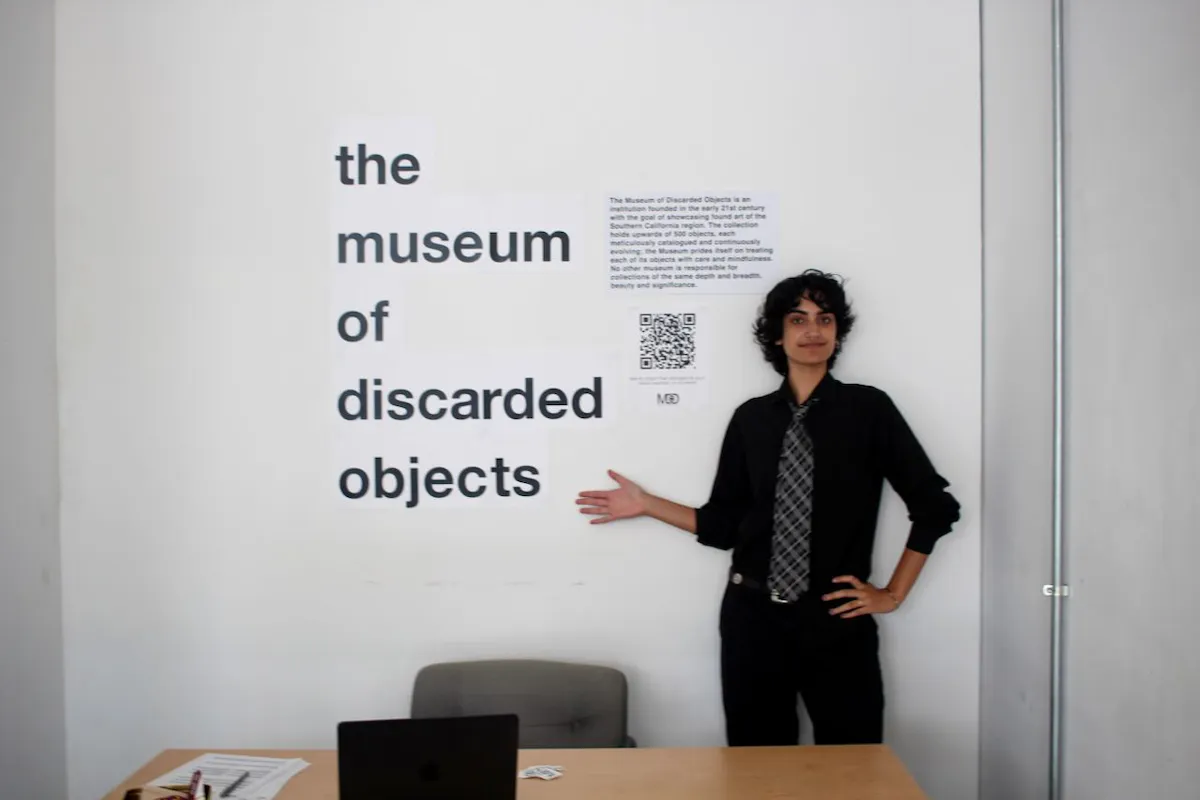
Professors Bryonn Bain and Ayasha Guerin pushed him to go even further than attempts to publish, (though Nadifi still will do that). The result was a small installation, presented as part of the department's senior showcase. Nadifi's "Do You Know What I've Seen?" invited visitors to sit inside a small tent, decorated to feel bedroom-like — a pile of books on a stool, a small desk with a laptop, a Tame Impala poster. On the computer screen, a scrolling panel of images traced examples of digital breadcrumbs that might lead young people to violent content. Viewers would touch the mouse and reveal a screen that shifted to an adapted survey, inviting them to contribute their own responses.
What Nadifi didn't anticipate was that when people sat down, they became part of the installation itself, read by others as performance art. The conversations that emerged around that perspective were rewarding, he said.
"So many people responded in so many different and unexpected ways," Nadifi said. "That introspection is definitely reflected in the survey responses I've read so far."
Maya Hazel Janaswamy has always been interested in systems and taxonomy — and also in what happens when you apply institutional logic to things institutions might never bother with.
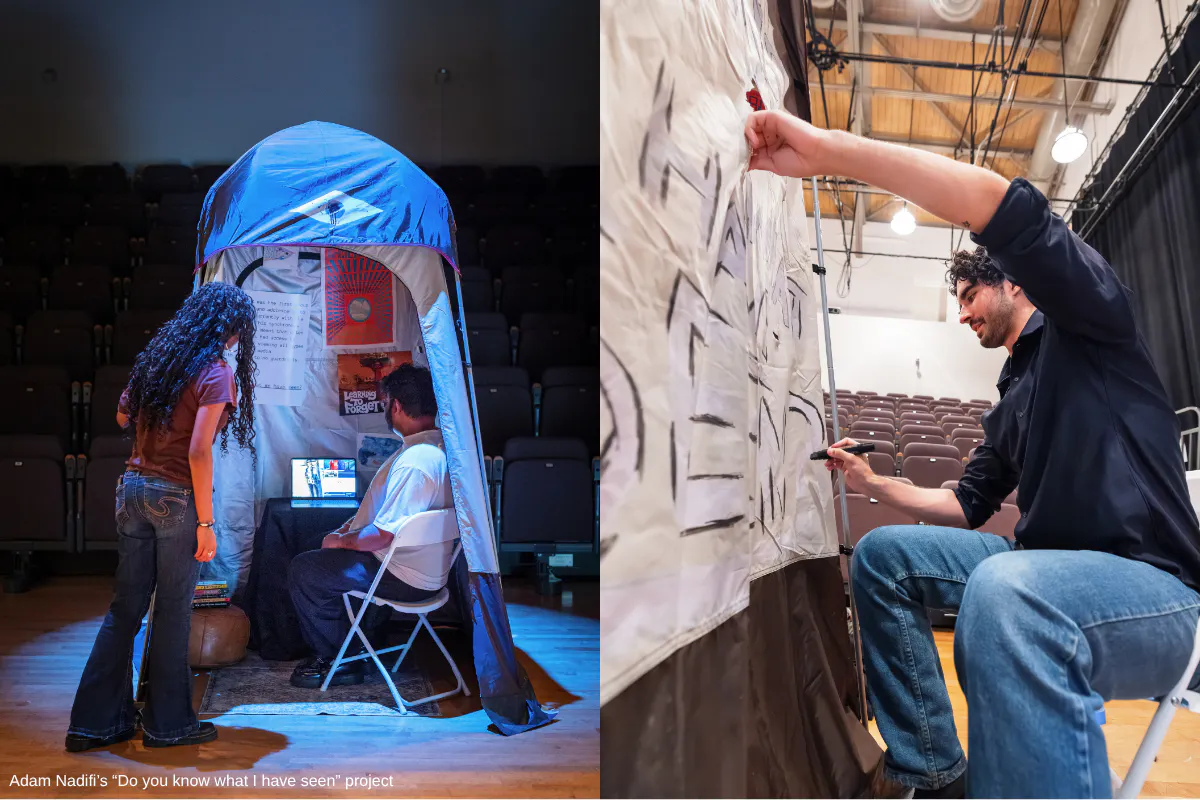
One esoteric project from their time at UCLA was "The Museum of Discarded Objects." Janaswamy created a fully realized "fake" exhibition, complete with acquisition numbers, wall labels and curator-led tours, built around objects people throw away every day.
"How does this institution determine the value of the person or the thing that comes out of it?" Janaswamy asked. It is a question that runs through everything they make. (Janaswamy has also built fluency in the "real" museum world, working at both the Hammer Museum and the Getty while at UCLA).
Their instinct for cataloging has taken many forms, including "Ring me, Beep Me," which allowed audiences to control the artist's movement by way of a soundboard reached via QR code, each sound triggering a different gesture.
Their capstone film, "The Ascension, Catalogued," shown at the 2026 Design Media Arts undergraduate exhibition, examines an online subculture built around rigid hierarchies of male attractiveness and self-optimization, drawing on beauty ratios that Janaswamy traces to 19th-century racial science.
"I see investigating the subculture as the first part of dismantling it," they said. "I want to broaden my understanding so that I'm better equipped to discuss it, debate it and de-influence it."
Both students are heading toward fields that they hope will keep them close to this kind of work — Nadifi potentially toward journalism or a role at an NGO, Janaswamy within the museum world.
"I'm letting myself follow that fascination wherever it takes me," Janaswamy said.