The Body in the Machine
Chelly Jin grew up in motion. Born in Arizona, she moved across continents and zip codes — South Korea, Louisiana, Ohio, Germany, Texas — never really long enough in any one place to fully take root. What she carried instead was a sense of herself as someone made from more than one world. Her mother is a graphic designer with a hard-won eye for form, her father an electrical engineer. It would take graduate school, and a thesis rooted in the history of computing, to fully understand how deeply she reflects them both.
Graduating with an MFA from UCLA's Design Media Arts program, where she also earned her bachelor's degree, Jin has developed a practice that moves fluidly between media art, choreography, performance, coding and installation. Her projects blur the boundary between digital and physical worlds, inviting audiences to interact with responsive systems. A space where technology becomes less about spectacle than attention, the increasingly rare act of being fully present with other people.
"I became really interested in creating systems," she said of her evolving practice. "Not necessarily telling people what to think, but building spaces where things can emerge."
Her thesis, "Software as Choreography," proposes something that sounds counterintuitive at first.
Jin's philosophy is that software is not, and has never been, disembodied. Her inspiration comes from the ENIAC, the first digital electronic computer built during World War II. It was operated by six women who spent days unplugging and replugging cables, flipping switches and turning dials to execute a single calculation. Jin views that unseen labor as a form of choreography.
"The first software is really a dance," she said.
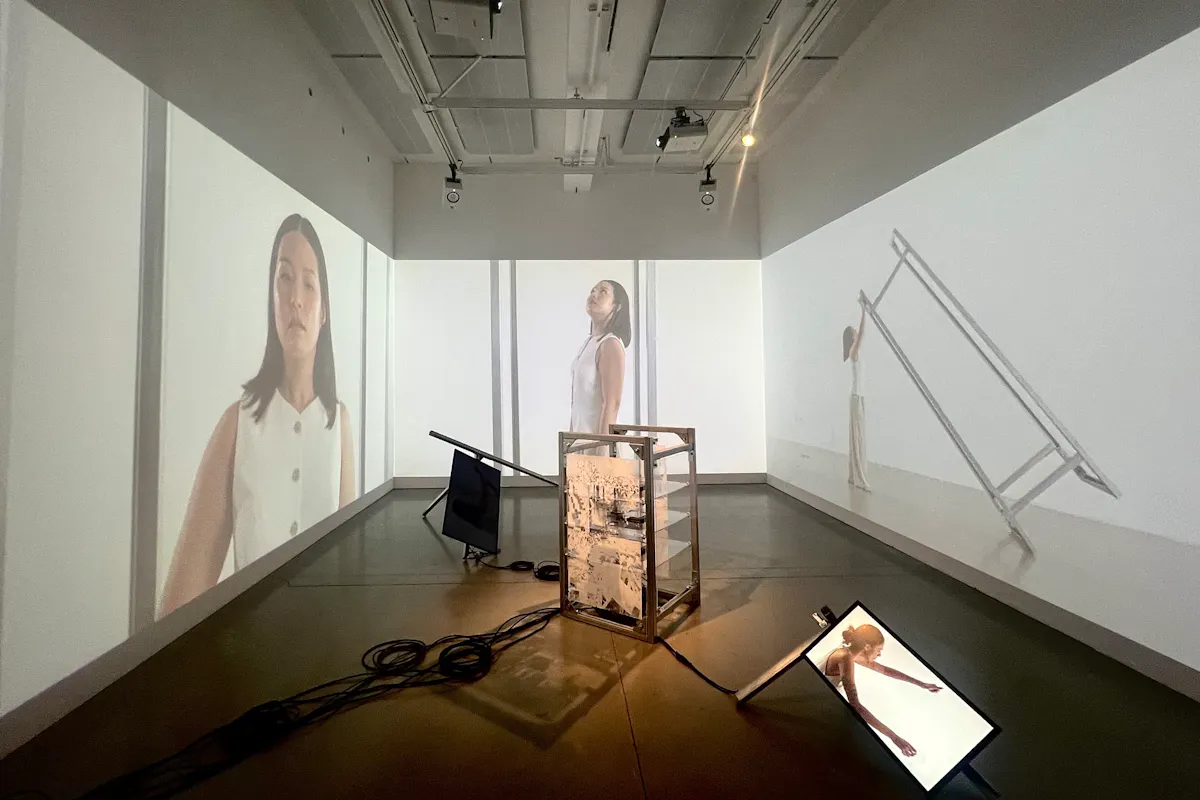
That insistence that the body and its labor remain present inside the machine runs through everything Jin makes. Her thesis installation in the New Wight Gallery unfolded across projections, monitors and metal strut structures resembling both server racks and echoes of ENIAC patch panels. Onscreen, Jin and a collaborating dancer perform movements abstracted from touchscreen gestures — swipes, taps and clicks — while three Mac Minis communicate through web sockets, determining which videos appear when.
The emotional center of the thesis emerged unexpectedly. During graduate school, Jin began speaking more deeply with her father about his work in semiconductor engineering. When she asked him to explain electricity, he described it as a beat, clapping his hands to demonstrate the pulse of on and off. Binary code, he explained, becomes a pattern layered onto that rhythm.
"I was like, is that not a dance?" she said, a realization that crystalized something Jin had been exploring for years, namely the intersection of engineering logic, design sensibility and embodied movement.
As an undergraduate, Jin created Diversity with Code and Art, an online curation of Asian women and gender-nonconforming artists that reimagined participation in open-source creative communities. A data visualization internship at NASA's Jet Propulsion Laboratory led to five years at Microsoft before ultimately bringing her back to UCLA and a graduate program expansive enough to support the creative risk she had been building toward.
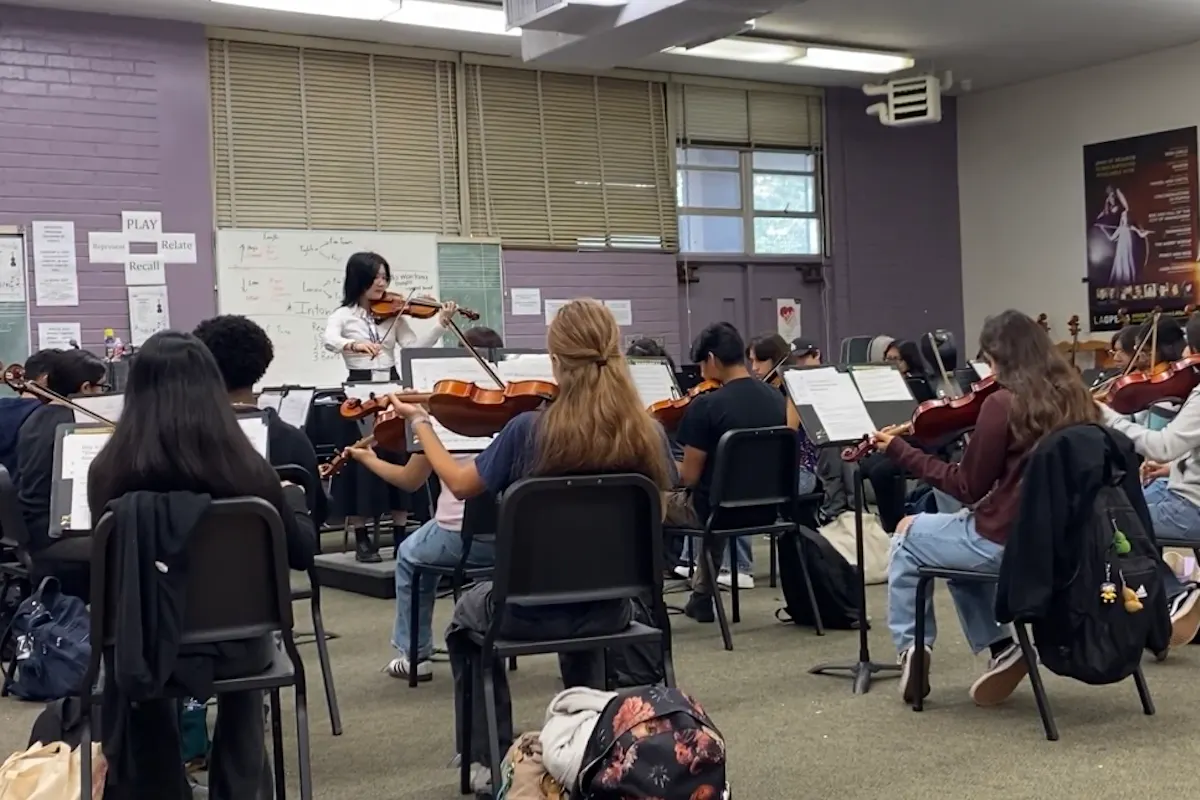
Also a violinist, Jin joined The Herb Alpert School of Music's Flux Ensemble in her final year, helping choreograph the movement of instrumentalists through space for experimental composer Yaz Lancaster's "Tangible Landscapes." She is also developing a digital theremin that uses hand-tracking software to translate finger movement into pitch and tone.
She plans to stay in Los Angeles after graduation and step into the city's art community with her building blocks from UCLA and a body of work that conveys and contains a method. Hers is a way of asking, in every medium, where the human went. Then finding it and rendering it anew.