Each and Both

She was in the middle of an oil painting when she got stuck on the color. She opened Illustrator, pulled up a digital color swatch, worked through it on screen. When she had it, she went back to the canvas. She carries a small set of watercolors wherever she goes. She uses CNC-cut (computer numerical code) wood to build physical objects designed entirely on a computer.
That back-and-forth has been the engine of Elisa Lopez Rochin's practice at UCLA. She graduates with a double major from the Departments of Art and Design Media Arts in the School of the Arts and Architecture.
"If I'm working with something physical and I'm struggling in some aspect," she said, "I'll go to the digital and kind of use that as a tool."
Lopez Rochin was born in California, but grew up in Sinaloa, Mexico until high school, when she moved with her sisters to Roland Heights to live with an aunt. During the COVID-19 quarantine she taught art classes to kids, volunteered at orphanages in Mexico, painting all the while.
She came to UCLA as an explorer and reveled in the opportunity to build expertise in mediums she hadn't touched before: ceramics, sculpture, photography, digital media. She added a double major in DMA her second year for the same reason — to keep exploring, to pick up more tools.
One piece she's particularly proud of started in a design research class with professor Peter Lunenfeld, whose coursework on L.A. as a site of inquiry had already shaped how she moved through the city. She'd been watching a video in which an artist described finding beautiful compositions in things people walk past without seeing — spilled Cheetos on the ground, the random scatter of objects on a sidewalk. She made a modular wooden board, CNC-cut, with pieces shaped like flowers, coins, leaves, a Cheeto. A Mexican coin sits next to a 2025 penny. A line runs across the board that looks random but isn't — it's a GPS map line pulled from the app Strava, drawn from the paths cut and tracked by her own walks, proving that inspiration can come from anywhere.
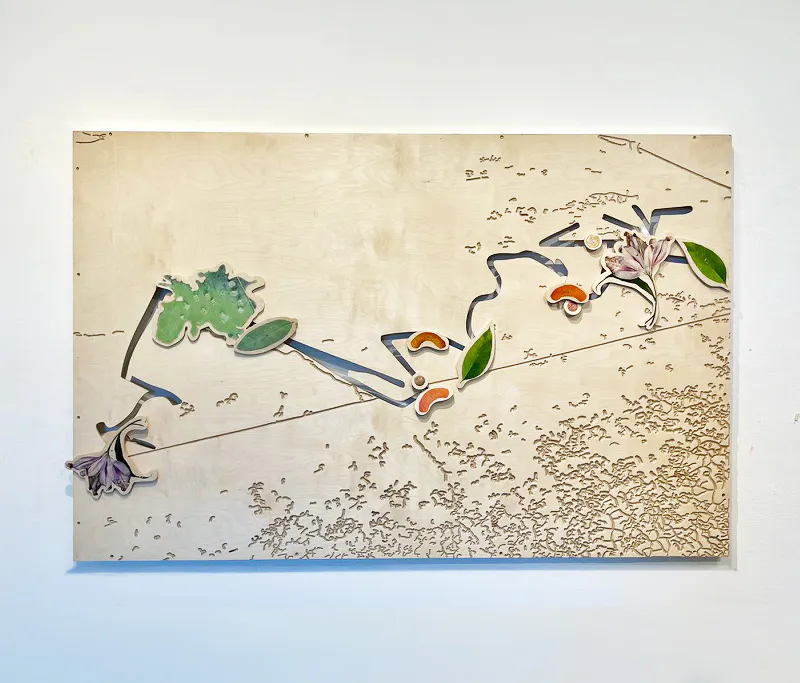
The piece treats the ground as an archive. Evidence of a specific time and place, composed by accident and attention at once.
She's taking the advice of lab supervisors and mentors who have encouraged students to work big while they can. Make the large canvases now, while the studio is available and the materials are accessible. She's already thinking about how much she'll miss the CNC machine, the scale, "the Fab Lab," all the things that disappear after graduation. Her DMA capstone project is a chair, fully designed in digital space and built by hand. Both degrees, one object.
After graduation, she wants to sustain a studio practice and work in collaborative creative environments — perhaps a design studio where large projects are built alongside other people. She's honest about not knowing exactly what that looks like yet. But she knows what she's looking for.